


 Damage
  Loss
Loss  Theft
Theft 


What Is a Pellet Grill & How Does It Work?
Whether you're a seasoned backyard pitmaster or just dipping your tongs into the world of outdoor cooking, one question keeps coming up: what exactly is a pellet grill, and how does it work? At Backyard Provider, we get more questions about pellet grills than almost any other product — and for good reason. These cookers have quietly transformed weekend barbecue culture, and once you understand the mechanics, it's easy to see why.
Pellet grills sit at the crossroads of a charcoal smoker, a gas grill, and a convection oven. They deliver consistent, hands-off cooking powered by compressed hardwood pellets — giving you authentic smoke flavor without the guesswork or the babysitting.
Why Pellet Grills Have Taken Over Backyards
Charcoal has soul. Gas has convenience. But pellet grills? They bring both — plus a level of precision that neither can match. Here's why pellet grills have become the go-to choice for outdoor cooking enthusiasts across the country:

How Does a Pellet Grill Actually Work?
A pellet grill is made up of several key components working in harmony: the hopper, the auger, the fire pot, the fan, and the control board. Together, these parts create a self-regulating wood-fired cooking chamber that holds a steady temperature for hours at a time.
Here's how the cycle unfolds:
Hardwood pellets sit in the hopper — typically on the side of the grill. As you cook, they feed downward into the auger by gravity.
A motorized metal screw (the auger) rotates slowly, pushing pellets from the hopper into the fire pot at a controlled rate. More pellets = higher heat. Fewer pellets = lower, smokier temperatures.
An electric hot rod ignites the pellets in the fire pot. Once combustion is established, the hot rod shuts off — the fire sustains itself.
An induction fan circulates hot air and smoke throughout the cooking chamber evenly — think convection oven, but with wood smoke. This eliminates hot spots and delivers consistent results from edge to edge.
Your temperature setting is fed to the digital control board, which adjusts the auger speed and fan output in real time to hold that exact temperature throughout your cook.
What Are Wood Pellets Made From?
Wood pellets are the lifeblood of a pellet grill. These are small, dense cylinders — roughly the size of a pencil eraser — compressed from 100% natural hardwood sawdust. No binders. No fillers. No chemicals. Just pure wood fiber pressed under high heat until the wood's own natural lignins fuse the pellet together.
Premium-quality pellets contain a higher percentage of cellulose and generate a cleaner, more consistent burn — resulting in better flavor, less ash, and more reliable temperature control.
Different wood species produce distinctly different smoke flavors. Matching your wood to your protein is one of the great pleasures of pellet grilling:
The Pellet Grill Control System
The digital control board is what separates a pellet grill from every other outdoor cooker. It transforms a wood-fire grill into a precision cooking instrument.
Early pellet grill controllers operated on simple stepped settings — Low, Medium, High — with only a rough correspondence to actual temperatures. The original pellet grill pioneers used a basic LMH controller system that adjusted auger cycles at timed intervals.
Modern pellet grills use sophisticated PID (Proportional-Integral-Derivative) controllers that read the actual cooking temperature dozens of times per minute, then make micro-adjustments to the auger feed rate and fan speed to hold your chosen temperature with remarkable precision — often within ±5°F of your setpoint.
"The best pellet grills of today offer Wi-Fi monitoring, multi-probe meat thermometers, and precision that rivals commercial kitchen equipment — at a fraction of the cost."
Advanced models offer additional capabilities: super-smoke modes that dial down airflow to maximize smoke production at lower temperatures, and high-heat searing zones that push surface temperatures above 700°F for a perfect steakhouse crust. In other words, today's pellet grills truly replace both the smoker and the grill.
A Brief History of the Pellet Grill
The pellet grill was born not in a commercial kitchen or a corporate lab, but in the workshop of a resourceful Oregon inventor who was tired of inefficient wood stoves.
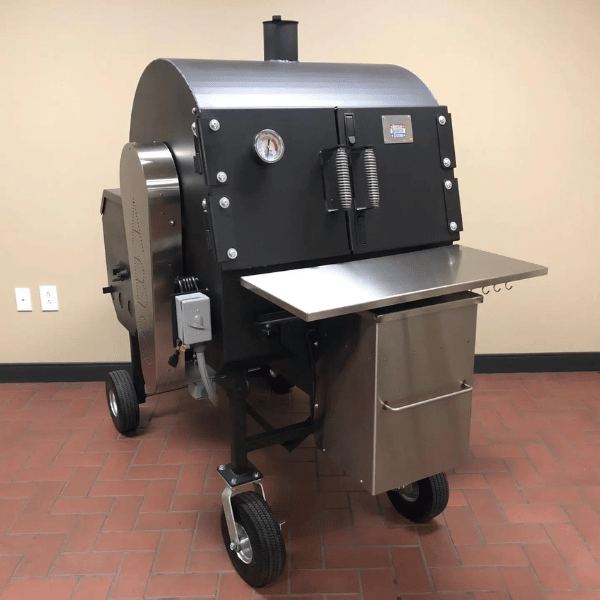
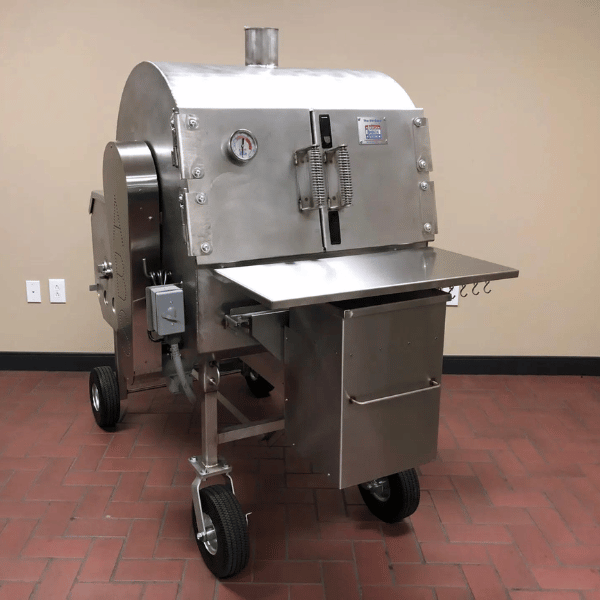
Robert T. "Bob" Traeger
Bob Traeger developed and patented the first pellet grill in the early 1980s. His insight was elegantly simple: replace unpredictable wood logs with precision-engineered fuel pellets, and add an electric auger to automate the feeding process. His initial patent in 1986 laid the groundwork for the entire pellet grill industry.
Is a Pellet Grill Right for You?
If you want real wood-smoke flavor without the learning curve of traditional offset smoking — and you want the flexibility to grill, smoke, roast, and bake on a single appliance — a pellet grill is almost certainly the right choice. Whether you're cooking a two-hour chicken on a weeknight or a fourteen-hour brisket for a weekend crowd, a pellet grill handles both with equal confidence.
The key is starting with a quality machine. Entry-level pellet grills cut corners on controller precision and build quality that you'll feel immediately. Investing in a well-engineered pellet grill from a trusted brand gives you years of reliable performance and flavor you simply can't fake.
Recteq X-Fire Pro 825 Pellet Grill
A high-performance pellet grill built for serious backyard cooks — with precision PID control, Wi-Fi connectivity, and 825 sq. in. of cooking space. Built to last. Built to impress.